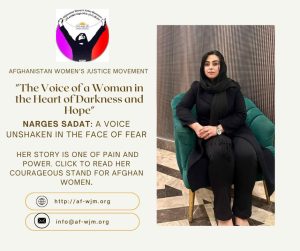
The Narrative of Resilience of Narges Sadat, Women’s Rights Activist and Leader of the Afghanistan Women’s New Future Movement.
Introduction
In the heart of the darkness of oppression, where the breath of protest is stifled in throats by threats and torture, the voice of Afghan women remains un silenced. The Voice of Women in the Heart of Darkness and Hope is an effort to document the stories of women who stood firm, even when the world turned a blind eye to their suffering.
The following narrative reflects the voice of a woman who has transformed pain into a cry for justice and threats into hope.
Methodology and Production Team
this interview was conducted in writing and online on May 26, 2025, based on a structured list of 15 questions from the Voice of Women in the Heart of Darkness and Hope program. To comply with the publication guidelines of the Afghanistan Women’s Justice Movement website, 10 selected questions along with their corresponding responses were chosen for public release.
The responses have been published verbatim, without any alterations, and stand as an authentic document of direct testimony.
Writer and Content Manager: Nasrin Faramarz – Independent researcher; holder of a Master’s degree in Criminal Law and Criminology; member of the Leadership Board of the Afghanistan Women’s Justice Movement.
Coordinator and Senior Consultant: Hoda Khamosh – Writer and founding of the Afghanistan Women’s Justice Movement.
Publications and Translation Manager: Hamia Naderi – Journalist and member of the Afghanistan Women’s Justice Movement.
- Please briefly introduce yourself.
I am Narges Sadat, a citizen of Afghanistan, born in 1995 in Karaj, Iran. I have studied English Literature and Language and hold a Bachelor’s degree in Law and Political Science.
- Before your arrest, what areas were you active in, and which civil movements or initiatives were you involved in?
I worked in the fields of women’s rights and social justice, particularly advocating for girls’ right to education in Afghanistan. I was an active member of the women’s movement, which aimed for gender equality and to combat tyranny. I collaborated with national and international human rights organizations and participated in awareness-raising programs and support for vulnerable women. I also worked with media outlets to amplify the voices of oppressed women and to document and report human rights violations. Due to these activities, I was threatened, pursued, and ultimately arrested by Taliban members.
- How were you treated during your arrest and transfer to prison? Were you allowed to contact anyone or defend yourself?
I faced violence and threats. I was arrested without an official warrant and without my family being informed. During the transfer to prison, my eyes and mouth were covered, and I was subjected to insults and psychological pressure. Upon arrival at the prison, I was placed in solitary confinement. I was denied contact with the outside world, including access to a lawyer or even my family. There was no legal process or opportunity for defense; the Taliban officials’ treatment of me was humiliating. I was terrified and under severe psychological stress and anxiety.
- What was your situation like during your detention? Were you tortured?
In the Taliban prison, I experienced various forms of physical and psychological torture, including repeated beatings, confinement in darkness, forced sleep deprivation, denial of food, threats of rape, verbal humiliation, and constant shouting. Day and night held no meaning for them; I was sometimes interrogated 5 to 6 times a day without reason or forced to record false confession videos. Their goal was to extract information about women’s protest movements, break my spirit, and force me into silence. They wanted to make me a symbol of fear for other women to silence their protests.
- In the darkness of prison, who or what did you think of that gave you hope and strength?
The memory of my son and his innocent voice saying, “Mom, don’t go alone!” was my only light of hope. The thought of the women I stood alongside, shouting for freedom, also gave me strength. I told myself that if I broke, the voices of many others would be silenced too. During those days, I spoke to God more often, praying to remain human. I whispered to myself, “God, don’t let the enemy see my tears.” Faith, maternal love, and belief in my cause kept hope alive within me.
- During your detention or interrogations, was there a moment when you felt you might give up?
Yes, the physical and psychological pressures during detention and interrogations were so intense that at times I felt I could no longer continue. Tortures like waterboarding and disregard for my menstrual needs were deeply distressing. But the hardest moment was when they imprisoned my ten-year-old son and threatened to harm him if I didn’t confess. That was the closest I came to surrendering.
- Did the experience of detention and pressure cause some women to withdraw from their activism?
Yes, the detention and severe psychological torture led some women to fall silent or step back temporarily. Some suffered from depression, others left the country, and some went into hiding. However, for others, this experience became a motivation to continue the struggle. Those of us who endured the pain decided to become a voice—through storytelling, education, and supporting others. For some, prison was the end; for others, it marked the beginning of a more aware and courageous chapter of resistance. - How did you manage to balance being a “mother” and a “fighter” in the heart of prison?
Balancing motherhood and activism in the Taliban prison was one of my hardest experiences. When I saw my son in that dark environment, I felt like I was being torn apart. But I believed that if I stayed silent, he would never understand the meaning of freedom. I had to stand firm so he would know his mother was tortured but never surrendered. I was resolute in front of my torturers, but to my son, I said, “Mom is strong, and you be strong too!” I was both a fighter and a mother; these two roles completed me. - After your release, what motivated you to establish the “Afghanistan Women’s New Future Movement”?
After my release, the only thing burning within me was that these pains should not remain silent. I didn’t want the next generation of girls to endure the torture I did. I founded the Afghanistan Women’s New Future Movement from the heart of pain and prison to be a voice for silenced women and a refuge for resistance and hope. Prison didn’t break me; it became the motivation to build this movement.
- If you could send one message to the world, what would it be?
Afghan women are not just fighting for their rights but for dignity and humanity. Hear our voice, do not leave us alone, and do not remain silent in the face of the injustice inflicted upon us. We want a world where women can live freely and equally without fear.
Final Word
Narges Sadat is not merely a women’s rights activist or a former prisoner; she represents a generation that refused to surrender before arrest and stood even stronger after release. This narrative is a testament to the resilience of Afghan women against the power of oppression and a reminder that no force can silence the voice of Afghan women.