


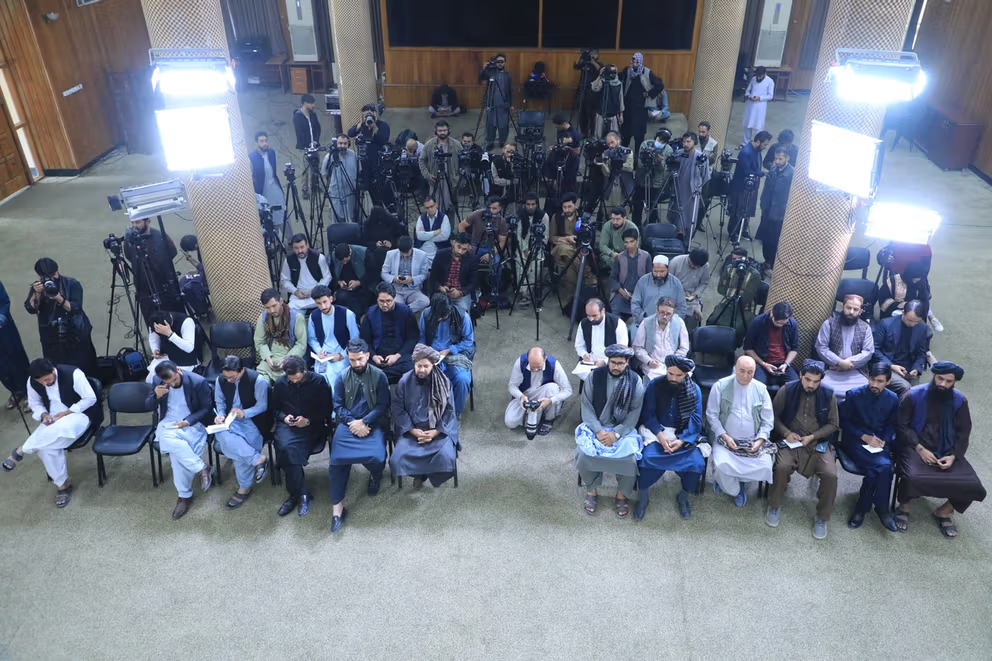
Human Rights Watch (HRW) has released a new report stating that the Taliban have completely dismantled media freedom and freedom of expression in Afghanistan over the past four years.
According to the report, since the Taliban’s return to power, Afghan journalists have faced waves of arbitrary arrests, censorship, torture, and forced self-censorship. HRW says that the Taliban’s intelligence agency and the Ministry for the Promotion of Virtue and Prevention of Vice monitor all media content, and even minor criticism of Taliban officials can result in detention or torture.
“Taliban officials force Afghan journalists to produce only ‘safe,’ pre-approved stories,” said Fereshta Abbasi, HRW’s Afghanistan researcher. “Anyone crossing the red line faces arbitrary detention and torture. Everyone has been affected, but women journalists have suffered the most.”
Torture and Prosecution
HRW reports that Taliban intelligence routinely detain journalists on accusations of spying, contact with opposition groups or exiled media, or reporting on ISIS-K or internal Taliban disputes. Taliban agents have raided media offices and journalists’ homes, confiscating phones and computers and accessing their contacts. Some have been arrested merely for speaking with foreign media.
Several journalists told HRW they were beaten so severely that their teeth or facial bones were broken. Others were released only after signing pledges never to work as journalists again, and many continue to suffer psychological trauma.
Publishing critical reports on Taliban officials, HRW warns, can lead to espionage charges or enforced disappearance, with families often denied contact for months.
Forced Self-Censorship
Fear of arrest has led many journalists to limit their work to official events, such as government projects or diplomatic visits. One Kabul-based journalist said he was detained twice simply for ignoring Taliban directives.
The Ministry for the Promotion of Virtue has raided media offices, banned filming people, and declared that depicting human faces is “haram” (forbidden in Islam). In Herat, one reporter said, “After a cultural event, we were only allowed to post photos of the empty hall — no faces could be shown.”
Taliban authorities have also ordered journalists to use terms like ‘Islamic Emirate’ instead of ‘Taliban’ and to publish more content in Pashto rather than Dari.
Uneven Restrictions
HRW notes that restrictions vary by region. In provinces like Kandahar, monitoring is much stricter, while pressure is somewhat lighter in central and northern provinces. A journalist told HRW, “You can go to Panjshir, but they’ll follow you. Without prior coordination, you’re not allowed to report.”
Even reporting from border areas with Iran or Pakistan now requires Taliban approval and supervision.
Ethnic minority journalists — particularly Hazaras — face harsher treatment. One Hazara journalist said Taliban intelligence officers mocked and threatened him during detention, saying:
“A Hazara boy dares to speak against us? We defeated the Americans — who are you? You’re nothing. We can make you disappear anytime we want.”
The report also says Taliban intelligence is especially active in Hazara-majority areas, and that they have banned Shia religious programming. A journalist preparing a report on a Shia cleric said he received threats warning he would “die under torture” if he published it.
Exiled Journalists at Risk
HRW warns that dozens of Afghan journalists in Pakistan and Turkey face the threat of deportation.
-
In Pakistan, many live without legal status and fear arrest and forced return.
-
In Turkey, most have no work permits or legal residency, surviving in precarious conditions.
HRW stressed that deporting Afghan journalists violates the principle of non-refoulement, as returning them to Afghanistan exposes them to torture and death.
A Warning to the International Community
HRW cautions that, without urgent international action, Afghanistan risks becoming a “silent nation.”
It urges governments worldwide to fulfill their pledges to protect Afghan journalists, halt all deportations, and pressure the Taliban to end arrests, torture, censorship, and restrictions against women.
The report is based on 18 remote interviews with journalists inside Afghanistan and 13 in-person interviews with exiled Afghan journalists and refugee organizations in Turkey.


https://shorturl.fm/KVVol
https://shorturl.fm/99V8V
https://shorturl.fm/dpdTO
Thank you for your sharing. I am worried that I lack creative ideas. It is your article that makes me full of hope. Thank you. But, I have a question, can you help me?
I enjoyed how considered and steady this felt. It’s easy to read but still leaves a real effect, and I appreciate you sharing it.
https://shorturl.fm/XWrEF