

The United Nations Assistance Mission in Afghanistan (UNAMA), in its latest report covering the human rights situation in Afghanistan from January to March of this year, has documented widespread violations of the rights of women and girls by the de facto authorities.
Findings from UNAMA reveal that Taliban morality police in several provinces instructed health institutions, shops, markets, government offices, and vehicle drivers not to provide services to women unless accompanied by a male guardian (mahram).
This report, based on monitoring by UNAMA’s Human Rights Section and prepared under the UN Security Council’s mandate, focuses particularly on the systematic restrictions imposed on women.
According to the report, the new academic year began on March 20, 2025; however, it marks the fourth consecutive year in which girls above sixth grade have been barred from attending secondary schools and universities.
So far, no official announcement regarding the reopening of schools for girls has been issued by the de facto authorities.
The report states that in Ghazni province, Taliban officials verbally ordered government departments to prevent women from entering without a male guardian.
In the Karukh district of Herat province, women were banned from visiting the Pashdan Dam. In Kandahar, women were denied entry to clinics without a male companion, and in Farah, taxi drivers refused to transport unaccompanied women.
In Herat, Taliban forces stopped several rickshaws and warned drivers against transporting women without a mahram. On March 3, a hospital in Kandahar was subjected to an unannounced inspection, during which staff were instructed to only treat women accompanied by a male guardian.
Ban on Work and Economic Activity
In another part of the report, UNAMA documented severe restrictions on women’s right to work, including bans on working in beauty salons, media outlets, and other business activities.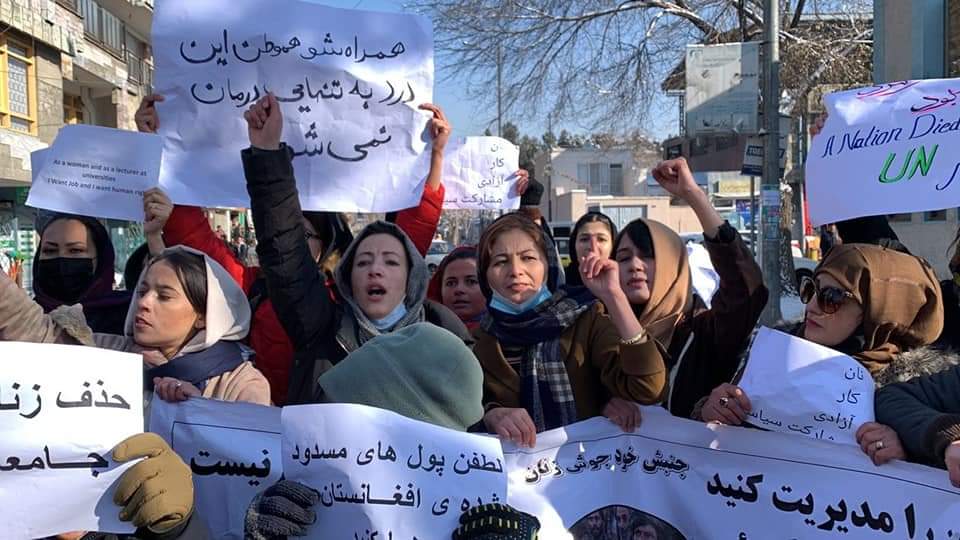
According to the report, in Badakhshan, Taliban border police blocked women from working in beauty services. In Sar-e-Pul province, Taliban morality police conducted door-to-door inspections, confiscating beauty products from homes where women’s salons were operating.
These inspections were reportedly conducted without judicial warrants and even in the absence of male family members.
UNAMA also recorded instances of gender-based violence during the reporting period.
According to the report, Taliban officials attempted to force a woman into marriage and pressured another woman to stay with her abusive husband despite being a victim of physical abuse.
UNAMA expressed grave concern over the ongoing severe restrictions on women’s freedoms and fundamental rights in Afghanistan and called for the immediate cessation of these discriminatory practices by the Taliban.
UNAMA Report: Reasonable Grounds for ICC Arrest Warrants Against Taliban Leaders
Referring to the January 23 statement by Karim Khan, the Chief Prosecutor of the International Criminal Court (ICC), UNAMA noted that the collected evidence justifies arrest warrants for Taliban leader Hibatullah Akhundzada and Chief Justice Abdul Hakim Haqqani.
The report states there are reasonable grounds to believe these individuals bear criminal responsibility for crimes against humanity, particularly gender-based persecution.
Following this announcement, the de facto Foreign Ministry issued a statement rejecting the accusations and claimed that the ICC lacks legal jurisdiction over these matters.
The statement added that the court “should not attempt to impose a uniform interpretation of human rights on everyone.”
UNAMA also reported that on February 19, the Taliban announced that they do not recognize the Rome Statute and consider the previous government’s accession to it legally invalid.

Gender-Based Violence and the Authorities’ Response
UNAMA documented several instances of gender-based violence, including forced marriages and coercion of women to remain in abusive relationships.
Meanwhile, on March 8, Taliban spokesperson Zabihullah Mujahid claimed that “all forms of violence against women have decreased” and that “women’s fundamental rights are being protected under Islamic Sharia.”
The Taliban’s Ministry for the Promotion of Virtue also claimed in a statement that it handled 84 women-related cases between February 19 and March 19, most of which were related to inheritance and forced marriages.
UN Report: Women Without a Male Guardian Banned from Visiting Health Centers, Recreational Sites, and Markets

Hamia Naderi
Hamia Naderi (b. 1992, Badakhshan) is an Afghan journalist and human rights activist, recognized as a fearless voice for women’s rights and social justice. With over...
Hamia Naderi (b. 1992, Badakhshan) is an Afghan journalist and human rights activist, recognized as a fearless voice for women’s rights and social justice. With over a decade of experience, she has documented migration, exposed Taliban gender apartheid, and amplified silenced Afghan women. A journalism graduate of Badakhshan State University, she has worked with multiple Afghan and regional outlets since 2015 and earned recognition for her bold, investigative reporting. Today, as a member of the Federation of Afghan Journalists in Exile and the Afghanistan Women’s Justice Movement, she continues to inspire and mobilize for change.

Leave a Comment
