


By Elina Qalam,
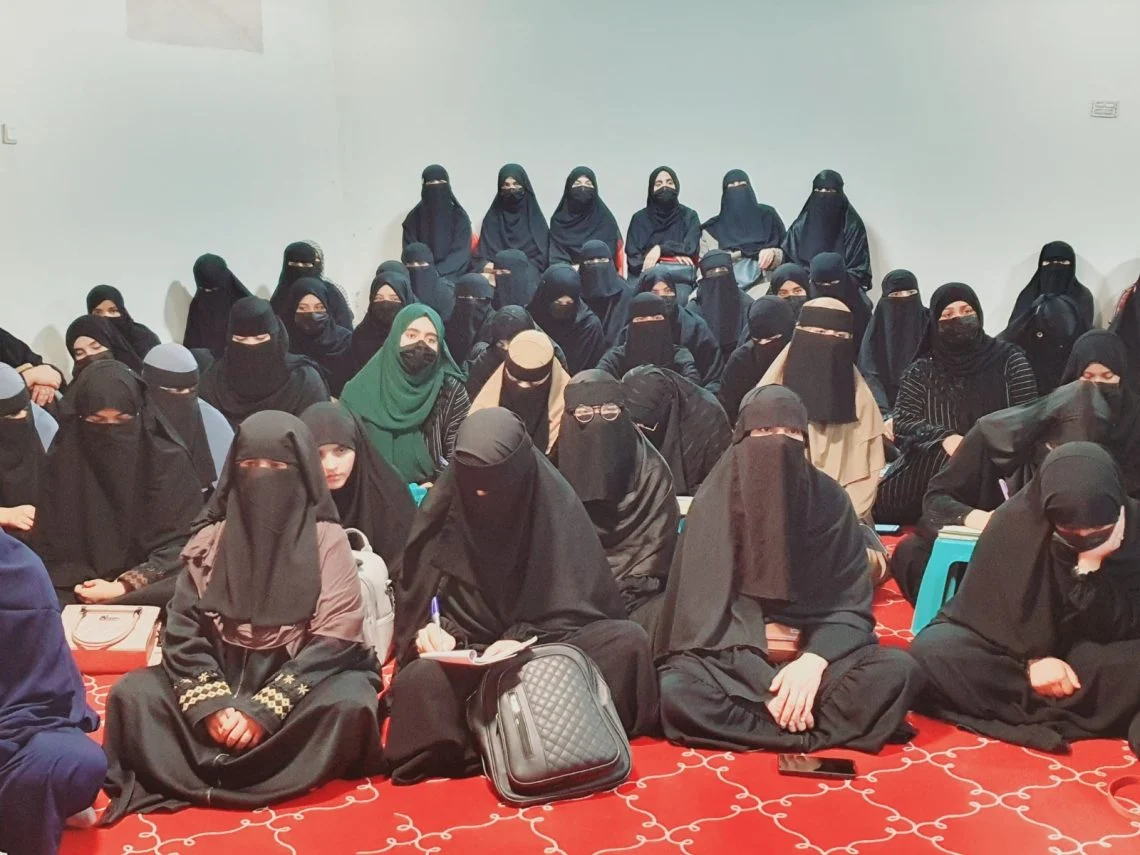
8AM Daily’s field report reveals that women and girls in some religious schools learn religious teachings in an extremely closed environment, mixed with fear and silence. The use of mobile phones is prohibited in these centers, and strict security measures — including full-body searches at entry and mandatory full coverings (burqa and mask) — are enforced. All girls are instructed to cover their faces, remain silent, avoid asking questions, walk quietly, not laugh, and be obedient and submissive.
Some students at these schools consider the restrictions imposed by the Taliban on women as “valuable actions.” Some describe the mandatory hijab for women as a “diamond.”
Teachers also instruct girls that women cannot marry without the permission of a male guardian (wali), and if a girl is married off by her father or grandfather during childhood, she has no right to annul that marriage after reaching puberty.
One cleric from a school investigated by 8AM said:
“If a man jokingly says to his friend, ‘Your daughter is my wife,’ and the other agrees, the acceptance and offer have occurred, and that little girl is religiously considered the wife of that man.”
After schools and universities were closed to girls, many turned to religious schools. Some girls say that in a situation where all doors are closed to them, they were forced to choose religious schools.
This report is based on field findings and interviews with girls from two religious schools in Kabul. These girls believe that in a situation where all doors are shut, they should take advantage of the opportunity to learn more about religion and Islam in these schools.
Findings show that the female students come from various social backgrounds, but most are from families with better economic status. These girls confirmed that they often felt lonely at home, which is why they turned to religious schools. They also confirmed that their families previously did not allow them to attend schools or universities, but now they can freely attend religious schools.
To escape loneliness and domestic pressures, some girls try to stay in class even after lessons, but the school administrators force them to leave and do not allow anyone to stay after class. Among these girls are unmarried women over 30 who prefer to spend more time at the religious school to escape the home environment.
In these two schools, there are also teachers from Pakistan.
Some girls express satisfaction with attending these schools, saying they have completely transformed into different people compared to before. They believe their moral and personal character has changed, but they still hope that schools and universities reopen soon.
For security reasons, the report refrains from mentioning the details of these girls’ identities. They said that before attending the religious schools, they did not know much about Taliban beliefs and practices, but after joining, even their style of dress changed.
They said that they previously wore colorful clothes and cared about their appearance, but now they wear black burqas and masks underneath because that is what they were taught at school.
Although these girls refer to the Hanafi school of thought, which states that covering the face is not obligatory, they say that due to societal insecurity, they prefer to cover their faces.
Most students at these schools said that the restrictions imposed by the Taliban on women are not bad but rather signify the “value of women.”
One girl, who still hopes that schools reopen, said that the Taliban’s religious police align their appearance with Islam, but it is unclear how much their hearts and inner selves align with Islamic teachings.
She recounted an incident where a girl wore glasses, but the Taliban enforcers did not allow her to use them, which she found very strange and thought-provoking.
This girl, despite not liking the burqa and believing that covering the face completely is not obligatory in their sect, was forced to wear a burqa and mask because the school taught that society is “corrupt.”
She believes that in Islam, women are not condemned to stay at home, but given the current circumstances, she is forced to accept it.
School Dress Code and Security Measures
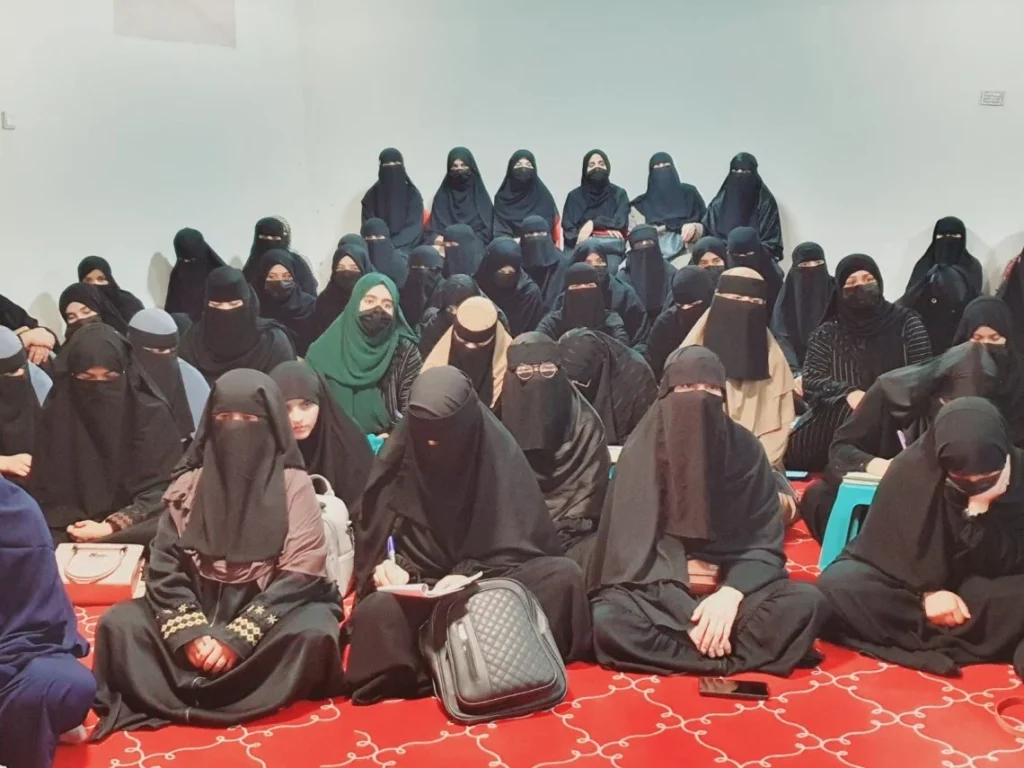
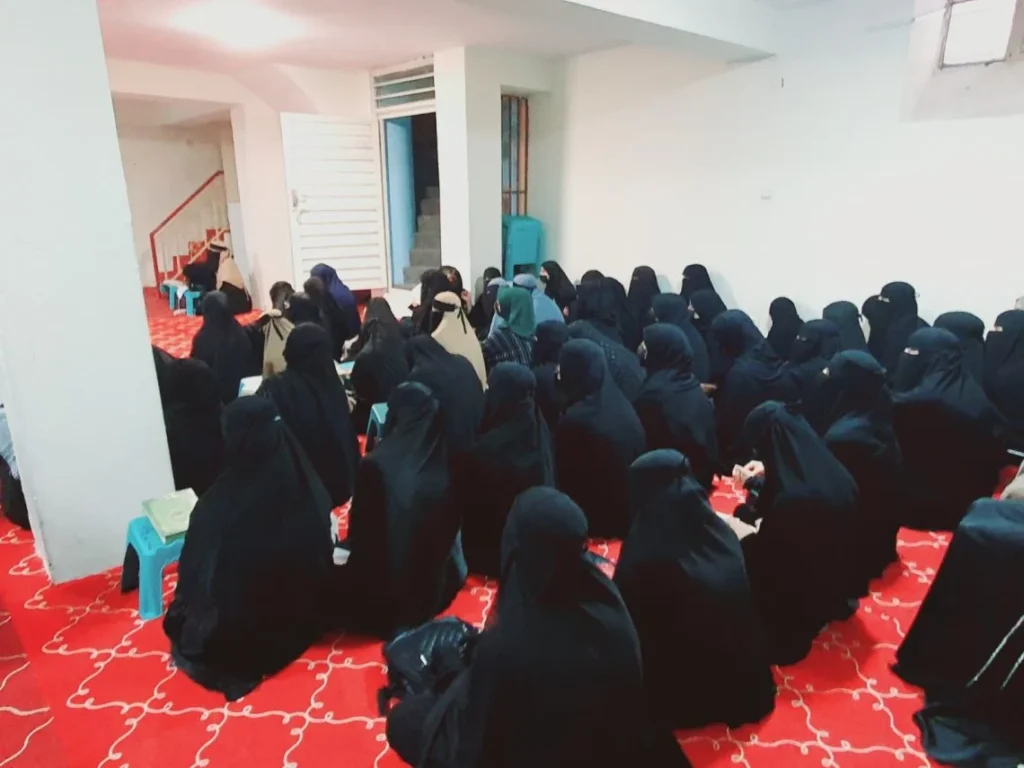
Girls attending these religious schools must wear black clothing covering them completely. Students are required to wear burqas and masks beneath and are not allowed to enter the school without full covering.
Everyone entering the school has a special ID card and is thoroughly searched at the entrance.
Female students have no chairs and sit on carpets, with small blue stools in front of them to place their books.
In one of these schools, mobile phones are prohibited, but complete silence is maintained in all classrooms and areas, which are equipped with security cameras.
The Experience Inside
8AM’s observations show that no one laughs, and no voices are heard; everyone is quiet and calm, as if fear permeates everywhere.
The atmosphere is sad, silent, and closed.
Women and girls are told to cover their faces, remain silent, walk quietly, not laugh, and always be obedient.
The material taught in classes lacks scientific basis and serves to deny women’s freedoms.
The space is dominated by fear, coercion, and silence.
Observations show that the girls are withdrawn and avoid conversation; it seems they have been instructed not to speak to anyone.
Even when approached warmly, they were not kind, instead watching intently and asking:
“Why are you not silent and why are you speaking or asking questions?”
Their responses were usually short and did not go further.
When asked about freedom, decision-making, and the future, most fell silent.
Some only responded with a smile or a short glance, as though afraid to express what they felt.
For many students, even thinking about “freedom” has become taboo.
When asked: “If it were your choice, would you still come here?” their expressions grew heavier.
Some lowered their heads, some hesitated and said, “I don’t know,” and one whispered: “We don’t have the right to choose, so the question is pointless.”
Findings indicate that silence is normalized in this environment.
Students sometimes even felt uneasy about another girl asking questions or speaking, as though only their bodies were present, while their minds were fleeing something invisible.
They avoided thinking, choosing, or even hearing their own voices in a simple conversation.
Some gazed innocently, while others’ looks were filled with fear and anxiety.
Many of these girls even saw marriage to Taliban members as entirely “positive,” saying:
“If you’re good, you’ll get a good husband — even if he’s a Talib, it doesn’t matter.”
Curriculum Content
Subjects taught include jurisprudence, theology, Quran memorization and interpretation, reading, and Arabic grammar.
One sample lesson focuses on women’s individual choice in marriage, titled “Male Guardianship Over Women.”
The content is not only taught in class but also shared in the school’s WhatsApp groups.
In one class, the teacher asks:
“Can a widow or divorcee marry without the permission of her father, brother, or guardian? If she does, is her marriage valid?”
Then he answers himself:
“Most non-Hanafi schools believe a woman cannot marry without a guardian. If she does, her marriage is incomplete and not religiously accepted.”
He attributes this view to a narration from the Prophet Muhammad, emphasizing that a girl has no right to marry without her guardian’s consent.
He continues that if a girl is married as a child by her father or grandfather, she cannot annul the marriage after puberty — calling this mandatory guardianship.
He adds:
“If a girl is married off as a child by her brother, uncle, or someone else (not her father or grandfather), she has the right to annul the marriage later.”
He recounts an example:
“In our class, one married student had a newborn daughter. Another joked, saying: ‘Congratulations! Why don’t you give her to me?’ The father replied: ‘Sure, take her.’ That constituted an offer and acceptance. Even though it was a joke, in Sharia, jokes in such matters count, and the baby became his wife.”
Social Media and Hijab Propaganda
Some madrasas use Facebook for propaganda.
In one video posted on Facebook, a young girl scolds another:
“Farashta, do you still dress like this? The world has changed!”
Farashta replies firmly:
“I’ve changed too — not to please others, but for myself and my God.”
Another girl joins in:
“Because of your opinions, I’m torn between wearing hijab or not!”
The first girl responds persuasively:
“You’re a diamond, Zahra. Diamonds aren’t displayed openly; they’re kept and covered because they’re precious. Hijab isn’t just clothing — it’s a symbol of dignity.”
Conclusion
Since taking power, the Taliban has banned girls above sixth grade from attending school and imposed dozens of other restrictions on women and girls.
This detailed report by 8AM Daily exposes how religious schools enforce gender apartheid, silence women, and deny them the right to think, choose, and speak — molding them into obedient shadows wrapped in black.
📌 This translation was prepared faithfully and in full from the original 8AM Daily report for publication on the Women’s Justice Movement website.


